Furnace Installation Colorado Springs: Plan It Before the Cold Does
A planned furnace install is a calm one day job. An emergency swap in January is not. This guide to furnace installation Colorado Springs covers local costs, the new ultra-low NOx rules, altitude derating and combustion checks, permits, and what a finished install should look like before the crew leaves.
- Written itemized quotes
- Altitude kit fitted as standard
- Permits pulled and inspected
- Local Colorado Springs team
Timing is the whole game
Most furnace installs finish in one day, with heat back on the same evening. The difference is when you book. A replacement planned in September lets you compare quotes, choose the right efficiency tier, and schedule the work on a mild day when the house does not need heat while the old unit is out.
The same job booked during a January failure happens under pressure, with the house cooling and pipes at risk. If your furnace is over 15 years old or needed repairs last winter, get quotes before the October cold rather than during the first failure. Hours are Mon to Sat 7am to 10pm and Sun 8am to 10pm.
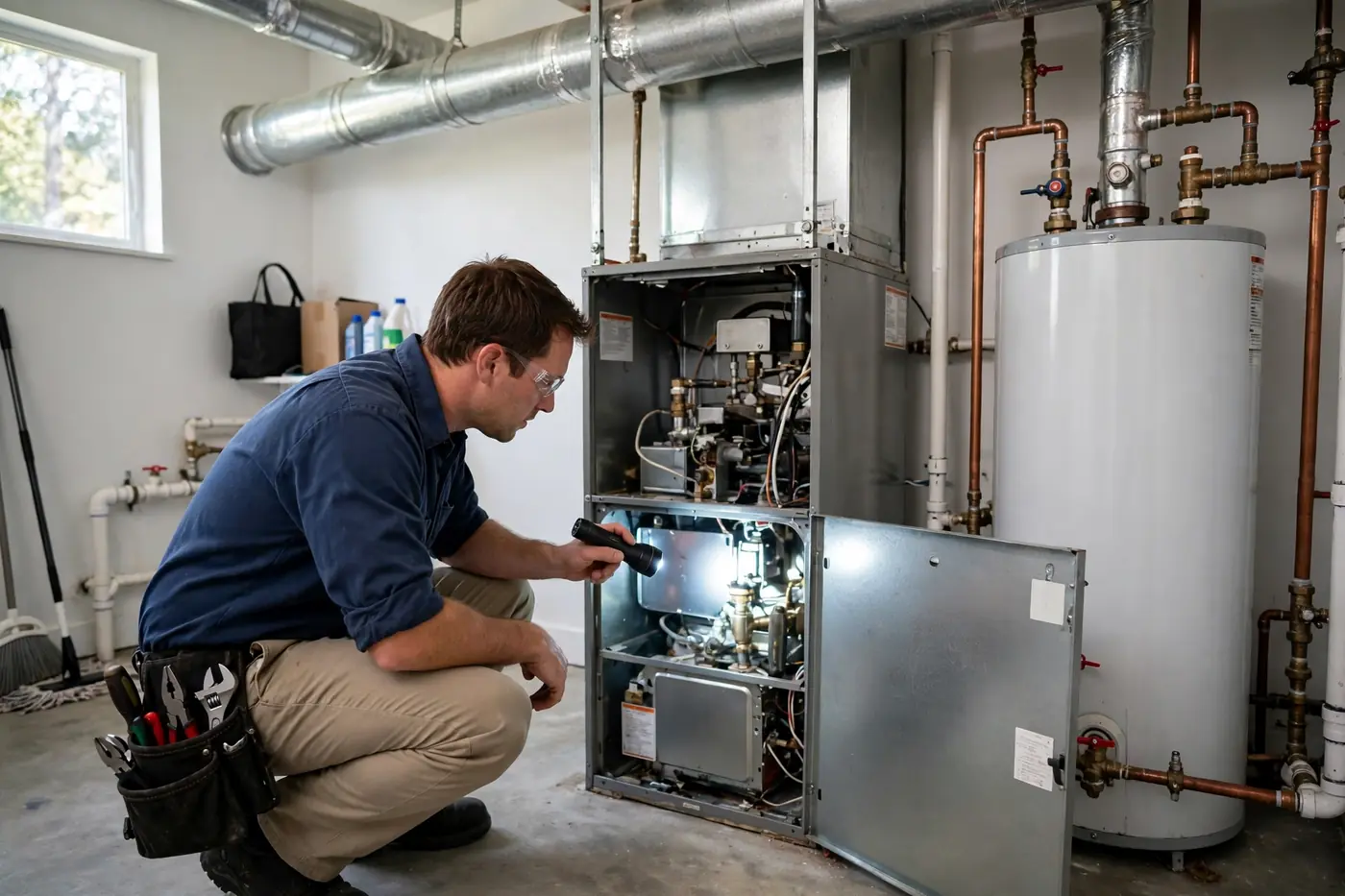
Furnace Installation Colorado Springs: What a New Furnace Costs
Most homeowners here pay $4,200 to $6,500 installed for a mid-efficiency gas furnace, and $8,000 and up for a high-efficiency model. Those are the published ranges on our furnace replacement cost guide. Your final price belongs in a written itemized quote after a load calculation at your home.
A furnace quote bundles more than the furnace. The equipment is one line. The sizing work, the altitude kit, the venting, the gas connection, the permit, and the labor are the rest of the job, and they are the lines a too cheap quote tends to leave out. Home size and heat load set the size of the unit. The efficiency tier sets the equipment price. Venting changes for a condensing model and the condition of your ductwork set most of the remaining spread between quotes for the same house.
| Job | Typical cost | What it covers |
|---|---|---|
| Mid-efficiency gas furnace, installed | $4,200 to $6,500 | The range most Colorado Springs homeowners pay, from our published replacement guide. |
| High-efficiency condensing furnace, installed | $8,000 and up | About 95 percent AFUE and higher in most current installs, with new venting and a condensate drain. |
| Ultra-low NOx compliant equipment premium | About $1,000 to $2,000 | Industry estimate for the added cost over older standard units. Confirm it inside your itemized quote. |
Published Colorado Springs ranges for a complete install. Your final price is always confirmed in a written itemized quote before work starts, with equipment, altitude kit, venting, permit, and disposal shown as their own lines.
The full tier table, the repair or replace maths, and the warning signs sit in the furnace replacement cost guide, so use it to check any quote line by line before you sign. If the furnace is being priced alongside a new air conditioner, the AC installation page covers the cooling half of the job, including how combined sizing works.
Ultra-low NOx furnaces: what House Bill 23-1161 changes
Under Colorado House Bill 23-1161, new gas furnaces sold or installed in Colorado since January 1, 2026 must meet ultra-low NOx limits or carry a qualifying ENERGY STAR certification. Working furnaces already in homes are grandfathered. The rule changes what you buy next, not what you own now.
Colorado House Bill 23-1161 set new emission limits for gas furnaces sold in the state. Since January 1, 2026, a new gas furnace sold or installed in Colorado must meet the ultra-low NOx limit of no more than 14 nanograms per joule for fan-type central furnaces, or carry a qualifying ENERGY STAR certification. NOx, short for nitrogen oxides, is part of the air pollution that comes from burning gas, and the rule is aimed at cutting it across thousands of homes.
In practice, most new installs are now condensing furnaces at about 95 percent AFUE or higher, because that is the equipment that meets the limit. Condensing models pull more heat from the same gas, vent through plastic pipe instead of a metal flue, and drain a small amount of water as they run. If your old furnace vented through a chimney or a shared flue, the venting changes are part of the install scope and belong in the quote.
Industry reporting puts the added cost of compliant equipment at roughly $1,000 to $2,000 over the older standard units. Treat that figure as an industry estimate, not a fixed surcharge, and check it inside real quotes. Your quote should name the exact model and its certification so you can check it against the rule yourself. A quote that just says new furnace, with no model number, gives you nothing to verify.
One point needs to be plain, because the rule worries people: existing furnaces are grandfathered. Nobody has to replace a working furnace because of this rule, and repairs to existing furnaces are unaffected. If your furnace can be repaired safely, the furnace repair page covers what common repairs cost. The new standard only applies when a new furnace goes in.
Derating, orifices, and the combustion test
Every gas furnace here must be derated by 4 percent for each 1,000 feet above 2,000 feet, a 16 to 24 percent input reduction at our altitude. The work uses high altitude orifices and pressure settings, and it ends with a combustion analysis left with you in writing.
The rule is simple: derate gas appliance input by 4 percent for every 1,000 feet above 2,000 feet. Colorado Springs sits at about 6,000 feet, so a furnace here needs a 16 to 24 percent input reduction. The work is physical, not a setting on a screen: high altitude orifices limit the gas flow, manifold pressure is set for thin air, and the pressure switch is matched to altitude so the furnace can prove its vent is clear before the burners light.
After the install, we run a combustion analysis with a meter in the flue and leave the readings in writing. The numbers show how cleanly the furnace burns and how much carbon monoxide is in the flue gases. They are your proof the altitude conversion was done, and they are the baseline for every later service visit. Keep them with the permit card and the warranty paperwork.
Skipping the altitude conversion is not a small miss. A furnace running sea level gas settings at 6,000 feet burns rich and hot, soots its heat exchanger, locks out, and wears out early. It can also void the manufacturer warranty, because the equipment was not installed to the maker instructions, and it can fail the city inspection. If a quote has no line for the altitude kit, ask why before you compare it with one that does.
From load calculation to lit furnace in three steps
Every install follows the same shape, whether it is a planned September replacement or a like for like swap. Knowing the shape helps you judge any quote you are given, and it shows you which steps a rushed job is skipping.
Load calculation and written quote
We measure the home, run a Manual J load calculation, and check ducts, venting, and gas supply. You get a written itemized quote that names the exact model and its certification, plus the altitude kit, the permit, and every line of work.
Install day
The crew protects floors, removes the old furnace, sets the new one, and reconnects gas, venting, and ducts. The altitude kit is fitted and set for 6,000 feet. Most installs finish the same day, with heat back on that evening.
Commissioning and walkthrough
We run a gas leak test and a combustion analysis, record the readings, and leave them with you. Then we set up the thermostat together and hand over the permit card and warranty paperwork before we leave.
We pull the permit, and the city checks the work
We pull the permit on every furnace install, the city inspects the finished work, and you keep the paperwork. That record protects you. An unpermitted install often surfaces at resale or at a later inspection, when fixing the record costs more than the permit and delays a closing.
Furnace permits carry weight because the job joins gas, combustion, and venting in one cabinet. The city inspection checks the gas connection, the venting, the condensate drain on condensing units, and the electrical work after we finish. That second set of eyes is part of what you are paying for, and the signed off inspection is your proof the install met code on the day it was done.
The resale problem is the one owners feel later. When a home is sold, an inspector or a buyer who checks permit records can flag an install that was never permitted. That can mean paying to correct work that was never checked, or crediting a buyer to close the sale. A permitted install with the inspection signed off turns that conversation into a simple one: you hand over the card and the file is closed. Read more about how we work if you want our approach set out in one place.
What a finished install should look like
A finished furnace install should look neat and test clean on paper. Venting is sealed, gas connections pass a leak test, commissioning readings are recorded and left with you, the thermostat is set up and explained, and a carbon monoxide check is done before we leave.
- Lines: gas and vent lines run straight and supported, with wall and roof penetrations sealed.
- Duct connections: neat and sealed at the plenum, with no gaps, crushed runs, or loose joints.
- Commissioning readings: recorded and left with the homeowner, including the full combustion analysis.
- Thermostat: set up and walked through with you, including the schedule and filter reminders.
- Paperwork: the permit card and warranty paperwork handed over, with model and serial numbers recorded.
- Venting on condensing units: sealed and sloped correctly, so condensate drains back instead of pooling in the pipe.
- Gas line leak test: completed on every new connection, with the result noted on the paperwork.
- Condensate drain: run properly to a safe drain point and tested with water before the crew leaves.
- Carbon monoxide check: done before we leave, with the reading shared and home detectors confirmed.
Walk the finished job with this list in hand before you make the final payment. A good furnace install looks plain in the best way: straight lines, sealed joints, a quiet first firing, and a folder of paperwork that matches what is in your utility room. If anything on the list is missing, ask for it on the spot, while the crew and the inspector can still put it right. That standard runs across all our heating and cooling services in Colorado Springs, not just installs.
Replace on your schedule, not the weather schedule
Local weather sets the trap. The first fall freeze lands around October 1 to 2, and furnaces that sat idle all summer tend to fail on their first hard firing, which is why no heat calls bunch up in October and again in the coldest January stretches. A furnace replaced in a shoulder season is a decision you made. A furnace replaced on a 10 degree night is a decision the weather made for you, usually with fewer choices and a colder house while you make it.
If your furnace is over 15 years old and showed any warning signs last winter, get quotes in September. You will have time to compare tiers, confirm the ultra-low NOx model in each quote, and check that the altitude kit and the permit are listed as lines. If the furnace is limping but safe, a repair can be the right bridge: the furnace repair page covers what common repairs cost, so you can weigh one more winter against a planned replacement with real numbers on both sides.
Questions before you book? Send the details through our contact page or call +1 (719) 555-0100 and describe the furnace: age, fuel type, and what it did last winter shape the advice more than any general guide can.
Planned replacements cluster where the winters bite hardest or the housing ages out together: up on the Palmer Divide in Falcon and Monument, where the altitude kit matters most; Briargate, where the 1990s builds are finishing their first furnace lives together; and the Broadmoor area, where larger older homes replace systems in planned stages. All three reward quoting in September rather than deciding in January.
Furnace Installation Questions
These are the questions homeowners ask us most before booking an install, answered plainly, including the new Colorado rule that worries people most. If your situation is not covered here, call +1 (719) 555-0100 and describe what your furnace is doing now and how old it is.
How much does furnace installation cost in Colorado Springs?
Most homeowners pay $4,200 to $6,500 installed for a mid-efficiency gas furnace, and $8,000 and up for a high-efficiency model. Those are the published ranges in our furnace replacement cost guide. Compliant ultra-low NOx equipment may add an industry estimated $1,000 to $2,000 over older standard units. Your final price should be a written itemized quote after a load calculation.
How long does a furnace installation take?
Most furnace installs finish in one day. The crew removes the old furnace, sets the new one, reconnects gas, venting, and ducts, fits the altitude kit, and runs a combustion analysis and commissioning checks before the walkthrough. Homes that need venting changes for a condensing unit, duct repairs, or a new condensate drain can take a second day, and that should be clear in your quote.
Do I need a permit for a new furnace?
Yes. A new furnace needs a permit in Colorado Springs, and the finished work is inspected by the city. We pull the permit as part of the job and hand you the paperwork. An unpermitted install often surfaces at resale or at a later inspection, when putting the record right costs more and can delay a sale.
What is an ultra-low NOx furnace, and do I have to buy one?
An ultra-low NOx furnace burns gas with far lower nitrogen oxide emissions, no more than 14 nanograms per joule for fan-type central furnaces. Under Colorado House Bill 23-1161, new gas furnaces sold or installed in Colorado since January 1, 2026 must meet that limit or carry a qualifying ENERGY STAR certification. If you buy a new gas furnace now, yes, it must be a compliant model, and your quote should name the model and its certification.
My current furnace still works. Does the new rule force me to replace it?
No. Existing furnaces are grandfathered under the rule. Nobody has to replace a working furnace because of House Bill 23-1161, and repairs to existing furnaces are unaffected, so a repair visit stays a repair visit. The rule only sets the standard for new furnaces sold or installed from January 1, 2026 onward. When your current furnace reaches the end of its life, the replacement will be a compliant model.
What size furnace does my home need?
Size comes from a Manual J load calculation that works from your home size, insulation, windows, and layout, then the furnace is adjusted for altitude. Gas input must be derated by 4 percent for each 1,000 feet above 2,000 feet, a 16 to 24 percent reduction here, using high altitude orifices and pressure settings. Ask any installer to show you the load calculation and the derating in writing.
Is it hard to replace a furnace yourself?
Honestly, yes, it is hard, and it is not a do it yourself job. A furnace install joins gas piping, combustion, venting, and electrical work, and it needs a permit and a city inspection. The parts a DIY install cannot do are the parts that keep a house safe: the altitude derating, the gas leak test, and the combustion analysis that proves the furnace is burning cleanly. A mistake with gas or venting can put carbon monoxide in the house and can void the manufacturer warranty.
Ready to plan your furnace replacement?
Call for a load calculation and a written itemized quote, with the model and its certification, the altitude kit, and the permit shown as their own lines. Hours are Mon to Sat 7am to 10pm and Sun 8am to 10pm.