Furnace Not Heating? What to Check Before You Call in Colorado Springs
A furnace not heating in Colorado Springs is a race against the cold. At our January design temperature of 7 degrees, an unheated house can put water pipes at risk the same night. This guide puts the safe checks in the order to run them, marks the lines you should not cross yourself, and shows how to protect the house while you wait for help.
- Written itemized quotes
- Prices published online
- Altitude-checked repairs
- Local Colorado Springs team
Two warnings come before every check
If you smell gas, get everyone out of the house, do not touch light switches or appliances, and call 911 or Colorado Springs Utilities from outside. If a carbon monoxide alarm sounds, get out into fresh air and call 911. No check on this page is worth doing before those two calls are ruled out.
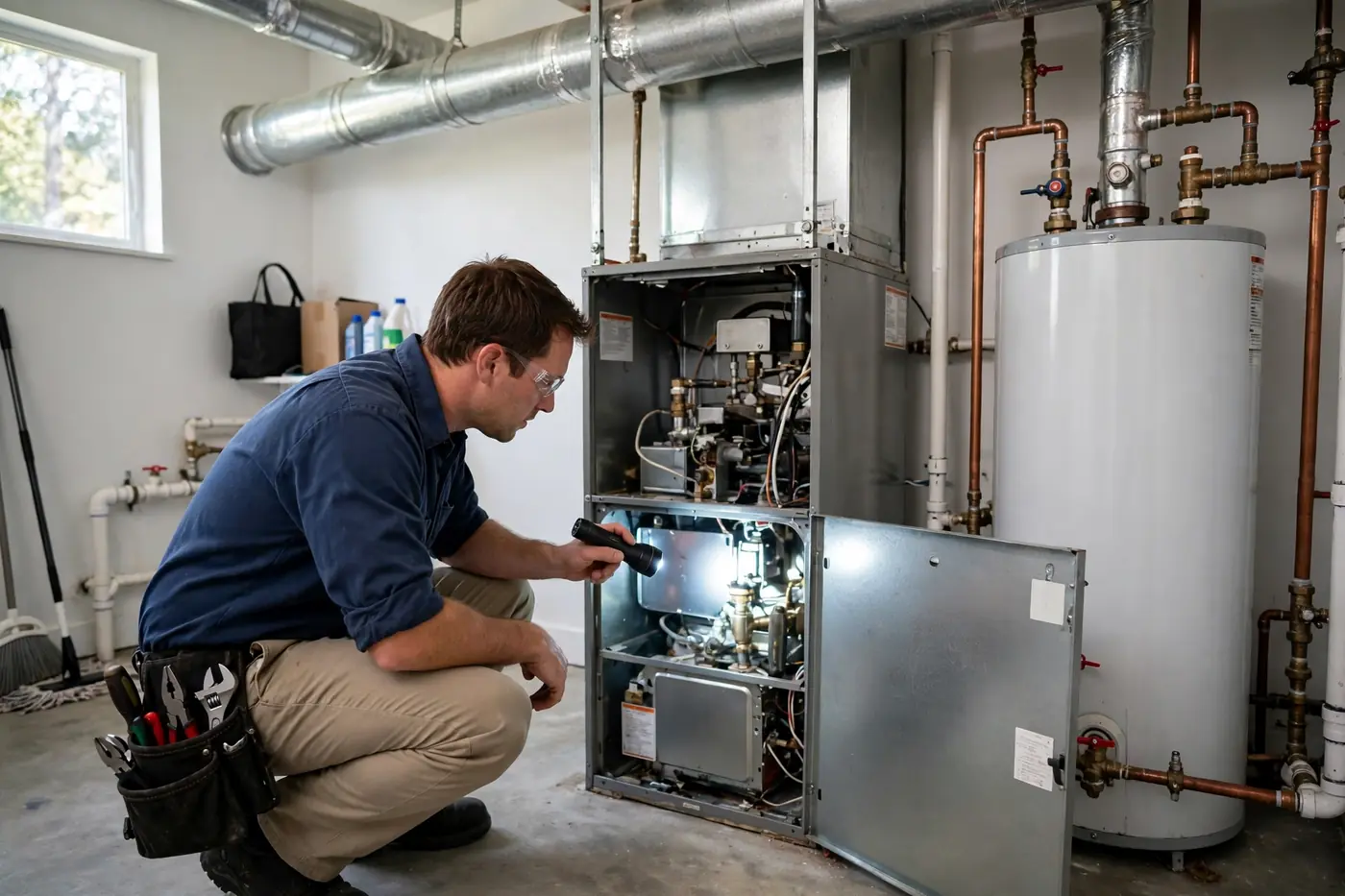
Safety first: gas and carbon monoxide come before any check
Smell gas? Leave first. Get everyone out of the house, do not touch light switches or appliances, and call 911 or Colorado Springs Utilities from outside or from a neighbor. If a carbon monoxide alarm sounds, get out into fresh air and call 911. A repair visit comes after the home is cleared as safe.
Carbon monoxide is the risk you cannot sense for yourself. A furnace with a cracked heat exchanger, a blocked vent, or a chimney fault can spill carbon monoxide into the house, and the gas has no smell and no color. Working carbon monoxide alarms on every floor and outside the sleeping areas are not optional in a heating city like this one. Headaches, dizziness, or nausea that ease when you leave the house are warning signs worth treating as an alarm even if no alarm has sounded.
One more line that matters on the coldest nights: never try to heat the house with an oven, stove burners, a grill, or a generator running in the garage. All of them produce carbon monoxide far faster than a room can clear it, and outage nights are when carbon monoxide poisonings happen. If the house cannot stay safely warm with the checks below and a space heater used properly, the right move is to sleep somewhere warm and let the repair happen in the morning.
Furnace not heating: the safe checks, in the order to run them
Work from the thermostat outward: heat mode and batteries, then the filter, the breaker and furnace switch, and the blower door. Look at the gas valve and the condensate drain without opening anything, note any blinking error light, and finish outside by clearing snow from the intake and exhaust pipes.
Before the checklist, watch one start attempt. Set the thermostat a few degrees above the room temperature and listen. What the furnace does next is the diagnosis in miniature: nothing at all, a click and a hum but no flame, burners that light and die within seconds, or a blower pushing air that never warms up. Write down which one you got, because a technician will ask, and the answer shortens the visit. Then work through the checks in order. Each one takes minutes, costs nothing, and between them they close out a good share of no-heat calls without a single tool.
- Thermostat: set it to Heat, a few degrees above the room temperature, with the fan on Auto rather than On. A dim, blank, or resetting screen usually means dead batteries, which stop more furnaces than any broken part.
- Filter: slide it out and hold it up to a light. If light cannot pass through it, change it and give the furnace a few minutes to retry. A filter clogged solid overheats the furnace and trips its limit switch, which looks exactly like a breakdown.
- Breaker and furnace switch: check the panel for a tripped breaker, then find the switch by the furnace that looks like a light switch. It gets knocked off by accident all the time, including the ones at attic entries and basement stairs.
- Blower door: the front panel presses a safety switch, and a panel left loose after a filter change stops the furnace dead. Push it firmly shut and listen for a restart.
- Registers and returns: open any supply vents that were closed for the summer and move furniture, rugs, and boxes off the return grilles, so the furnace can move the air it heats.
- Error light: look through the small window on the furnace panel for a blinking light and count the pattern. Do not take the panel off to chase it. The count is what the technician needs, and it is stored in the board even if the furnace later restarts.
- Gas supply: try another gas appliance. If the stove and water heater are also out, the problem is the gas supply, not the furnace. The valve handle beside the furnace should sit parallel to its pipe, which means on. If it sits across the pipe and nobody in the house turned it off, leave it alone and call. Never keep relighting a pilot that will not stay lit.
- Condensate: furnaces with white plastic vent pipes make water as they run. Find the drain hose or the small pump beside the furnace. A pump reservoir full of water, or a drain hose that is kinked or frozen where it crosses an unheated attic or crawlspace, trips a safety switch and stops the furnace. Emptying a pump reservoir is fine. Bypassing its float switch is not.
- Outside intake and exhaust: the two plastic pipes on the side of the house clog with wind-blown snow here, sometimes overnight. Clear snow and ice away gently by hand, and check them again after every storm while the cold lasts.
Attic furnaces and crawlspaces
Plenty of Colorado Springs homes keep the furnace in the attic or in a crawlspace, and the same checks apply, with one change of emphasis. On an attic furnace in a cold snap, suspect the condensate line first: it runs through unheated space, freezes before anything else, and shuts the furnace down on its safety switch. In a crawlspace, work the list in the same order and take a flashlight. If reaching the unit means an icy ladder or a crawl you are not comfortable making, that is a fair stopping point. Skip it and say so when you call.
The altitude fault a homeowner cannot fix
Some no-heat faults only show up in deep cold here. At about 6,035 feet, a furnace proves its vent is clear with a pressure switch that reads air pressure, and thin air gives that switch less to read. A furnace that was never derated for altitude, at 4 percent for each 1,000 feet above 2,000 feet, can light happily on mild days and lock out when it has to run hard. No homeowner adjustment exists for that, and guessing helps nobody. If yours starts, runs briefly, and quits only on the coldest nights, note the pattern and tell the technician, because that exact pattern is a known fault on our furnace repair page.
What not to touch, and when to stop and call
The checks above all happen outside the furnace cabinet or with a panel pushed shut. Everything in this section is past the line, and the line exists for a plain reason: a gas furnace joins a fuel supply, a flame, and a vent in one box, and the parts that keep that safe are exactly the parts a curious homeowner is tempted to bypass.
Leave these to a technician
- The burner compartment: burners, the gas valve and its internal parts, and the manifold stay closed. If a part inside has failed, that is the diagnosis a visit is for.
- The hot surface igniter: it is fragile ceramic, and the oil on bare fingers shortens its life. A dark igniter is a finding to report, not a part to handle.
- Gas pressure settings: manifold pressure is set with a meter against the altitude derating. There is no safe version of adjusting it by feel.
- Any safety switch: never jump, tape, or bypass a pressure switch, limit switch, rollout switch, or door switch. A switch that keeps tripping is reporting a fault, and defeating it removes the protection without touching the cause.
- Endless resets: two resets is the limit. Past that, each retry can stress parts and mask the fault the technician needs to see.
- Vent and flue joints: do not pull apart or retape vent piping. A leaking joint is a carbon monoxide path, and it needs proper sealing and a combustion check afterward.
Stop and call now if
- A carbon monoxide alarm sounds, or you smell gas. Leave first, call 911 or the utility, and only then call us.
- The furnace bangs or booms when it tries to light, which points to delayed ignition.
- You smell burning, see scorch marks, or hear the blower screaming or grinding.
- Water is pooling at the base of the furnace.
- The furnace locks out again after the checks and two resets.
- The house is at 50 degrees and still falling, anyone vulnerable is home, or a sub-zero night is coming with no fix in sight.
Calling is not giving up on the cheap fix. The checks above have already ruled out the free causes, and what is left needs testing equipment. A diagnostic visit inside our hours, Mon to Sat 7am to 10pm and Sun 8am to 10pm, costs far less than the burst pipe a long cold night can leave behind.
Protect the house while you wait: pipes set the clock
Pipes begin to freeze at about 20 degrees Fahrenheit. In an unheated house, water in pipes can start to freeze after roughly six hours below freezing, and exposed pipes on outside walls can freeze in two to three hours. That clock, not comfort, sets the deadline on a cold night.
If the furnace will be out for more than a few hours, work this list while the house still holds its heat. At the 7 degree design temperature, an unheated house can fall below freezing inside in about a day, and faster on windy nights or in homes with plumbing on outside walls. Every step below is about buying time on that clock and limiting the damage if a pipe does freeze.
- Drip the faucets: run a slow stream, about the width of a pencil lead, at faucets fed by outside walls. Moving water resists freezing, and the open tap relieves pressure if a section does ice up, which is what actually bursts pipes.
- Open cabinet doors: under every sink on an outside wall, so warm room air reaches the pipes inside.
- Pick one warm room: close the doors to unused rooms, hang a blanket over a hallway opening if you need to, and keep everyone, pets included, in the room you are heating.
- Use a space heater by the rules: flat on the floor, three feet clear of bedding, curtains, and furniture, plugged straight into a wall outlet and never into an extension cord or power strip. Choose one with tip-over and overheat shutoffs, and never leave it running in an empty room or while you sleep.
- A fireplace helps if it is sound: open the flue first, burn only proper firewood, and close the damper again once the fire is fully out.
- Hold the heat you have: close curtains and blinds, keep exterior doors shut, and put a rolled towel along the gap under the front door.
- Find the main water shutoff now: it is usually in the basement, the crawlspace, or the meter box. If a pipe bursts, that valve is the difference between a mop and a flood.
Your water heater deserves one line here. While it runs, it keeps its own tank hot, so the tank itself rarely freezes. The exposed part is the piping that feeds it across a cold garage or crawlspace, and that piping gets the same treatment as the rest: drip the nearest faucet and let warm air reach it. If the wait stretches into days and the house will sit empty and unheated in deep cold, dripping is no longer enough. The safe endgame is to shut the water off at the main and drain the lines, or have a plumber do it, rather than gamble the whole plumbing system on a repair slot.
If the furnace fails while you are away
An empty house cools on the same clock as an occupied one, with nobody home to hear the furnace quit. Before winter trips and PCS moves, set the thermostat to 55 degrees or higher, which is the setting widely cited to protect pipes, and leave a key with a neighbor who will walk through during cold snaps. A smart thermostat with a low-temperature alert earns its money in exactly this situation, because it phones you while the house is still warm enough to save.
If an alert lands while you are away, treat it as a pipe emergency even though the house is empty. Call for the visit, pass along the neighbor's number so the technician can get in, and have the neighbor start the faucets dripping in the meantime. Landlords across the military rental belt get the same advice from us at every winter turnover, because a burst pipe in an empty rental is the most expensive version of this story. Moves deserve their own version of this list: our PCS move-in HVAC checklist covers the vacant-house weeks before a handover and the first days in the new house after one.
What a no-heat visit involves, and what it costs
When you call, describe what the furnace does in your own words, plus anything the checks turned up: the error light pattern, the dead filter, the snow you cleared off the pipes. That detail shapes what the technician loads and tests first. The diagnostic visit is $89, confirmed before anyone is dispatched. On the visit, the technician runs the start sequence step by step, tests the parts your symptoms point to, checks gas pressure and combustion, and confirms the altitude settings. You then get the fault in plain words and a written itemized quote before any part is fitted. The invoice is in your hand before you pay, and there are no tip screens. The full picture of the service, including the local price table, is on our furnace repair page.
Most common repairs land between $100 and $900 for parts and labor. A flame sensor clean or replacement is often $100 to $300, a hot surface igniter $150 to $350, and blower motors and control boards sit at the high end. If your repair lands outside that range, the quote will show why, line by line, before you agree to anything.
Sometimes the honest answer is that the furnace should not be repaired at all: a cracked heat exchanger, or a major part gone on a furnace deep into its second decade. Run the $5,000 rule before you decide, multiplying the age of the furnace by the repair cost, and if the result passes $5,000, replacement usually deserves a hard look. Our furnace replacement cost guide sets out the local replacement prices beside the repair maths. And if a crack is the diagnosis, whoever you use, ask for camera proof of your own heat exchanger and the carbon monoxide reading in writing before you sign anything.
Questions homeowners ask on no-heat calls
These are the questions that come up on the phone while a house is cooling. If yours is not covered, call +1 (719) 555-0100 and describe what your furnace is doing. The exact words help: nothing at all, lights then stops, or blows cold each lead somewhere different.
Does letting faucets drip really prevent frozen pipes?
It helps, and it buys time rather than immunity. A slow drip, about the width of a pencil lead, keeps water moving, and, more importantly, it leaves the tap open so pressure cannot build behind an ice plug, which is what bursts pipes. Pair it with open cabinet doors on outside walls, and treat it as a bridge to a repair, not a fix.
Will my water heater freeze if the furnace is out?
The tank itself is unlikely to freeze while the water heater is running, because it keeps its own water hot. The risk sits in the pipes that feed it across a cold garage, crawlspace, or outside wall. Give those pipes the same treatment as any other: drip the nearest faucet, open nearby doors so room air reaches them, and if the house will sit empty and unheated for days, ask about draining the system instead.
How many times can I reset my furnace before I have to call?
Twice. A reset clears the lockout, and if the cause was a one-off, the furnace will run and keep running. If it locks out again, the safety switches are reporting a real fault, and repeated resets can stress parts and hide what is actually wrong. After the second failed run, stop resetting it and book a diagnostic visit.
Can I heat the house with my oven or a grill while the furnace is out?
No. Ovens, stove burners, grills, and generators all produce carbon monoxide, and using them for heat is a common cause of carbon monoxide poisoning during outages. Use a space heater in one room under the safety rules, or a fireplace with the flue open. If the house cannot stay safely warm, stay with family, friends, or a hotel for the night.
What will it cost to get my furnace heating again?
The diagnostic visit is $89, confirmed before anyone is dispatched. Most common repairs in Colorado Springs land between $100 and $900 for parts and labor, with flame sensors and igniters at the low end and motors and control boards at the high end. You get a written itemized quote before any work starts, so the repair itself never comes as a surprise.
This guide is the homeowner half of a no-heat call. The other half is a technician with the right parts on the truck and the testing gear to prove the fault before replacing anything. When the checks run out, book the visit through our furnace repair service, and when the season turns and the same system will not cool, the rest of the team is on our page for AC repair in Colorado Springs. When the house is warm again, more homeowner guides cover the decisions that come next, from choosing a heating system to what this altitude does to all of them.
Checks done and still no heat? Call before the pipes are at risk
Published prices, an $89 diagnostic visit, and a written itemized quote before any work starts. Hours are Mon to Sat 7am to 10pm and Sun 8am to 10pm.
Call +1 (719) 555-0100